
Why AI Agents Need to Check Their Own Work
Most AI agent architectures have a critical blind spot: they generate an output and immediately return it to the user without any validation step. This is like a developer pushing code to production without running tests. Self-verification, where the agent checks its own work before presenting results, is the single most impactful technique for improving agent reliability in production systems.
Self-verification works by adding an explicit validation step after the agent generates its output. The simplest form is a separate LLM call that reviews the output against the original requirements: "Does this response actually answer the question? Is every claim supported by the retrieved sources? Are there any logical inconsistencies?" More sophisticated approaches include executing generated code and checking for errors, validating structured outputs against schemas, cross-referencing facts with authoritative sources, and running domain-specific checks (like verifying that mathematical calculations are correct).
The key insight is that generation and verification are fundamentally different cognitive tasks, and models perform better when these are separated into distinct steps rather than trying to do both simultaneously. An agent that generates an answer and then critically evaluates it will catch errors that a single-pass system would miss. The article covers practical implementation patterns: verification prompts that maximize error detection, multi-round refinement loops where the agent iterates on its output until verification passes, confidence scoring to flag uncertain outputs for human review, and fallback strategies for when verification fails repeatedly. These patterns are framework-agnostic and can be added to any existing agent architecture with minimal refactoring.
TL;DR
Self-verification is the missing piece in most AI agent architectures. Here's how to build agents that validate their own outputs before returning results.
Key Takeaways
Self-verification, checking output before returning it, is the highest-impact technique for production agent reliability.
Generation and verification are different cognitive tasks, separating them into distinct LLM calls catches errors that single-pass systems miss.
Implement verification as a separate prompt that reviews output against requirements, source accuracy, and logical consistency.
Add confidence scoring to flag uncertain outputs for human review, and fallback strategies for repeated verification failures.
Quick announcements before we dive in:
I’m heading to AWS re:Invent in Las Vegas this week! If you’re attending, I’d love to connect in person. Feel free to shoot me a message on LinkedIn and let’s meet up.
Also, for Black Friday I’m offering special discounts on sponsorships and collaborations through December 6th. If you’re interested in partnering, check out the current options and reach out.
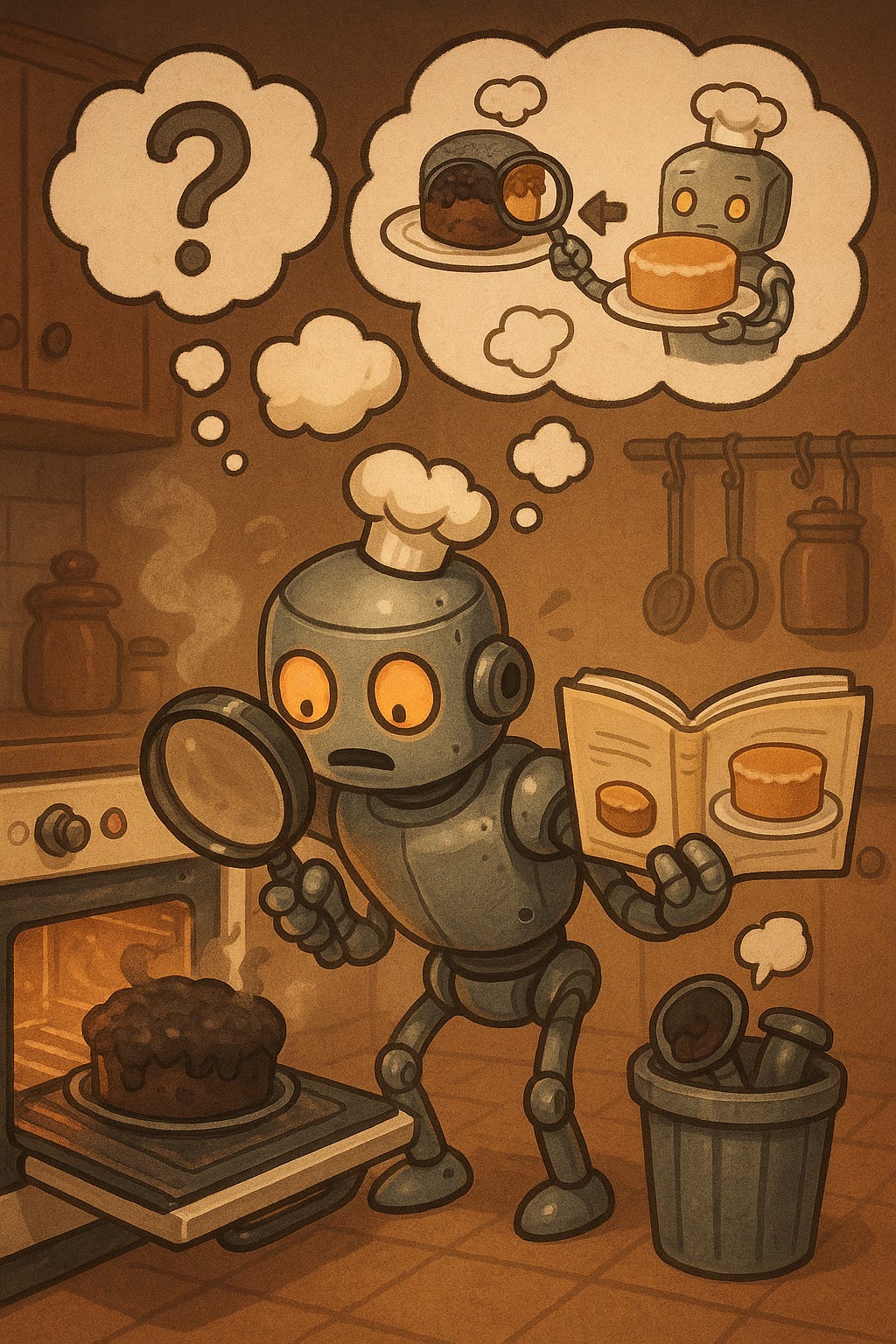
Picture yourself baking a cake from a new recipe. You mix the ingredients, slide the pan into the oven, and set a timer. What happens next separates amateur bakers from experienced ones. An amateur walks away and waits for the timer. An experienced baker peeks through the oven door, tests with a toothpick, and adjusts the temperature if things look off. That simple act of checking and adjusting is a feedback loop. It’s how we make sure a process stays on track.
Now imagine an AI agent trying to schedule your meetings, research a complex topic, or plan your weekend trip. Without the ability to check its own work and adjust course, that agent is like the amateur baker who just sets a timer and hopes for the best. Sometimes it works. Often it doesn’t.
This is where semantic control loops change everything. They give AI agents the ability to peek through the oven door, so to speak. They transform aimless assistants into focused problem-solvers that can adapt when reality doesn’t match the plan. Let’s explore how this works and why it matters.
Feedback Loops in Everyday Life
Consider your home thermostat. You set it to 22°C. The thermostat measures the actual temperature. Too cold? Heat turns on. Too warm? Heat turns off. This happens constantly, creating a continuous cycle of measuring, comparing, and adjusting.
This simple device embodies a powerful idea called a feedback loop. It senses the current state, compares it to the desired state, and acts to close the gap. The thermostat doesn’t understand why you want 22°C or care about your comfort. It just knows how to keep adjusting until the numbers match.
Feedback loops appear everywhere once you start looking. Autopilot systems keep aircraft level. Cruise control maintains your car’s speed. Your inner ear helps you balance without falling. Each system follows the same pattern: sense, compare, adjust, repeat.
But here’s the thing. All these examples deal with numbers. Temperature. Speed. Altitude. Balance. What happens when the goal isn’t a number at all?
Beyond Numbers
Say you ask an AI assistant to schedule a meeting with Bob and Carol for next week. This task has layers of complexity that a simple thermostat could never handle. The AI needs to understand who Bob and Carol are, check multiple calendars, find a time that works for everyone, send invites, and confirm attendance.
Success isn’t hitting a target number. Success means everyone can actually attend. That requires understanding the meaning behind the task, not just matching signals.
A human assistant would instinctively notice conflicts and adjust. They understand what “successfully scheduling a meeting” actually means beyond the mechanical steps. The question becomes: how can an AI develop that same intuition?
This is where feedback loops evolve from mechanical to meaningful.
Understanding Meaning
Semantic control loops describe feedback that goes beyond numbers. The loop checks whether actions are fulfilling the intended goal, not just matching a measurement.
For a thermostat, both the goal and the feedback are numbers. Current temperature versus target temperature. Simple math.
For an AI scheduling meetings, the goal involves understanding. Did everyone confirm? Are there conflicts? Does the timing make sense? The feedback isn’t a number. It’s about whether reality matches the intended outcome.
This means the agent must grasp what success looks like. A confirmed meeting isn’t just sent invites. It’s everyone saying yes. Any gap between intention and reality becomes a signal to adjust strategy. Maybe propose a different time. Send a reminder. Ask about availability first.
Continuous Adaptation
Modern AI agents operate in a continuous loop. Think about what to do. Act on that plan. Check the results. If the outcome isn’t right yet, loop back and try something different based on what was learned.
This differs fundamentally from older approaches. Early software followed rigid scripts. Step one, step two, step three. Like following a recipe with no room for adjustment. These open-loop systems had no mechanism to incorporate feedback during execution. If something unexpected happened, they either failed or got stuck.
Imagine a cleaning robot following a fixed script. It always takes the same path through your home, no matter what. New furniture in the way? It gets stuck. Unexpected spill? It drives right past. The robot executes its program without reflection.
Now imagine a smarter robot with a semantic feedback loop. It senses obstacles and adapts its path. It notices the spill and pauses to clean it. The robot’s true goal isn’t following a specific path. It’s cleaning your home. The feedback loop keeps that goal in focus and allows flexibility in achieving it.
The first robot is like an actor reciting memorized lines. The second is like an improviser who stays true to the story while adapting to what happens on stage.
Self-Correction Matters
Without self-checking feedback, AI agents easily drift off course, get trapped in loops, or confidently produce answers that miss the point entirely.
Think about an AI researching a topic and writing a report. Without a feedback loop, it might grab the first information it finds, draft an answer, and call it done. The report exists, so mission accomplished, right?
With a semantic control loop, the agent reads its own draft. It realizes key points are missing or irrelevant information crept in. So it loops back. Gather more data. Reorganize the content. Check again. Keep refining until the report actually answers the question well.
This isn’t just working faster. It’s working smarter. The feedback guides each step, turning a mechanical process into something that resembles understanding.
Planning a Mountain Trip
Let’s walk through a real example. You ask an AI assistant to plan a weekend mountain trip. This task has many moving pieces: choosing a destination, booking travel and lodging, checking weather, suggesting activities. You expect a coherent plan at the end.
The assistant starts by finding a popular mountain town and some hotels. Then it checks availability and discovers every hotel is fully booked. Without a feedback loop, the assistant might just present this broken plan. Hotels exist in the database, task complete.
But with a semantic control loop, the assistant notices the gap between intention and reality. The goal isn’t listing hotels. It’s creating a workable trip. So the assistant adapts. Maybe it tries a different town or different dates. Perhaps it looks at cabin rentals instead of hotels. It keeps proposing solutions and evaluating them, checking each time whether all the pieces fit together.
This cycle continues until everything aligns. Destination, lodging, transportation, weather-appropriate activities. You receive a full itinerary that actually works because the AI kept adjusting whenever reality didn’t match the goal.
Four Key Benefits
Semantic control loops make AI agents robust, reliable, and genuinely useful. When surprises happen, the agent adapts instead of breaking. It stays focused on what you actually want rather than veering into irrelevant territory. You can follow its reasoning step by step, making the process transparent and debuggable. Each feedback cycle teaches the agent something new, building competence over time.
Related Tutorials
Free Resources
Download free guides, cheatsheets, and templates curated from 130+ tutorials on RAG, AI Agents, and Prompt Engineering.
Also available on Substack
Prefer Substack? This article is also on our newsletter, read by 40K+ AI engineers.
Related Articles
Your First AI Agent: Simpler Than You Think
A beginner-friendly guide to building your first AI agent from scratch, covering what agents really are, how they work, and step-by-step instructions to build one.
How to Choose Your AI Agent Framework
A practical comparison of AI agent frameworks, when each shines, their trade-offs, and how to choose the right tool for your project.
How to Stop AI Hallucinations
AI hallucinations are one of the biggest challenges in production AI. Here are battle-tested techniques to minimize and control them.
Get More AI Insights Weekly
Join 40K+ AI engineers getting deep dives on agents, RAG, and prompt engineering every week.