
How to Stop AI Hallucinations
AI hallucinations, when a model confidently generates false, fabricated, or unsupported information, remain the single biggest barrier to deploying AI in production. This isn't a minor annoyance; in healthcare, legal, financial, or any high-stakes domain, a hallucinated fact can have serious consequences. The good news is that a set of battle-tested techniques has emerged that can reduce hallucinations dramatically when applied systematically.
Retrieval-Augmented Generation (RAG) is the most effective technique. Instead of relying on the model's training data (which may be outdated or incomplete), RAG retrieves relevant documents from a trusted knowledge base and includes them in the prompt. This grounds the model's response in actual source material. But RAG alone isn't enough, you also need structured output formats like JSON schemas or function calling, which constrain the model's output space and prevent free-form hallucination. When the model must output structured data that matches a schema, there's no room for creative fabrication.
Multi-step verification adds another layer of protection. After the model generates an initial response, a second pass (or a separate model) checks every claim against the source documents. This catch-and-correct pattern is similar to how humans proofread their work, the generating step and the verifying step use different cognitive strategies. Temperature and sampling parameters also matter significantly: lower temperature produces more deterministic outputs, and techniques like nucleus sampling can reduce the probability of low-confidence (and often hallucinated) tokens. The article provides specific parameter recommendations and a complete anti-hallucination checklist for production deployments.
TL;DR
AI hallucinations are one of the biggest challenges in production AI. Here are battle-tested techniques to minimize and control them.
Key Takeaways
RAG (Retrieval-Augmented Generation) is the most effective technique, grounding responses in retrieved facts dramatically reduces hallucinations.
Structured output formats (JSON schemas, function calling) constrain the model's output space and prevent free-form hallucination.
Multi-step verification where the model checks its own output against source material catches many hallucinations before they reach users.
Temperature and sampling parameters matter, lower temperature means more deterministic, less hallucination-prone outputs.
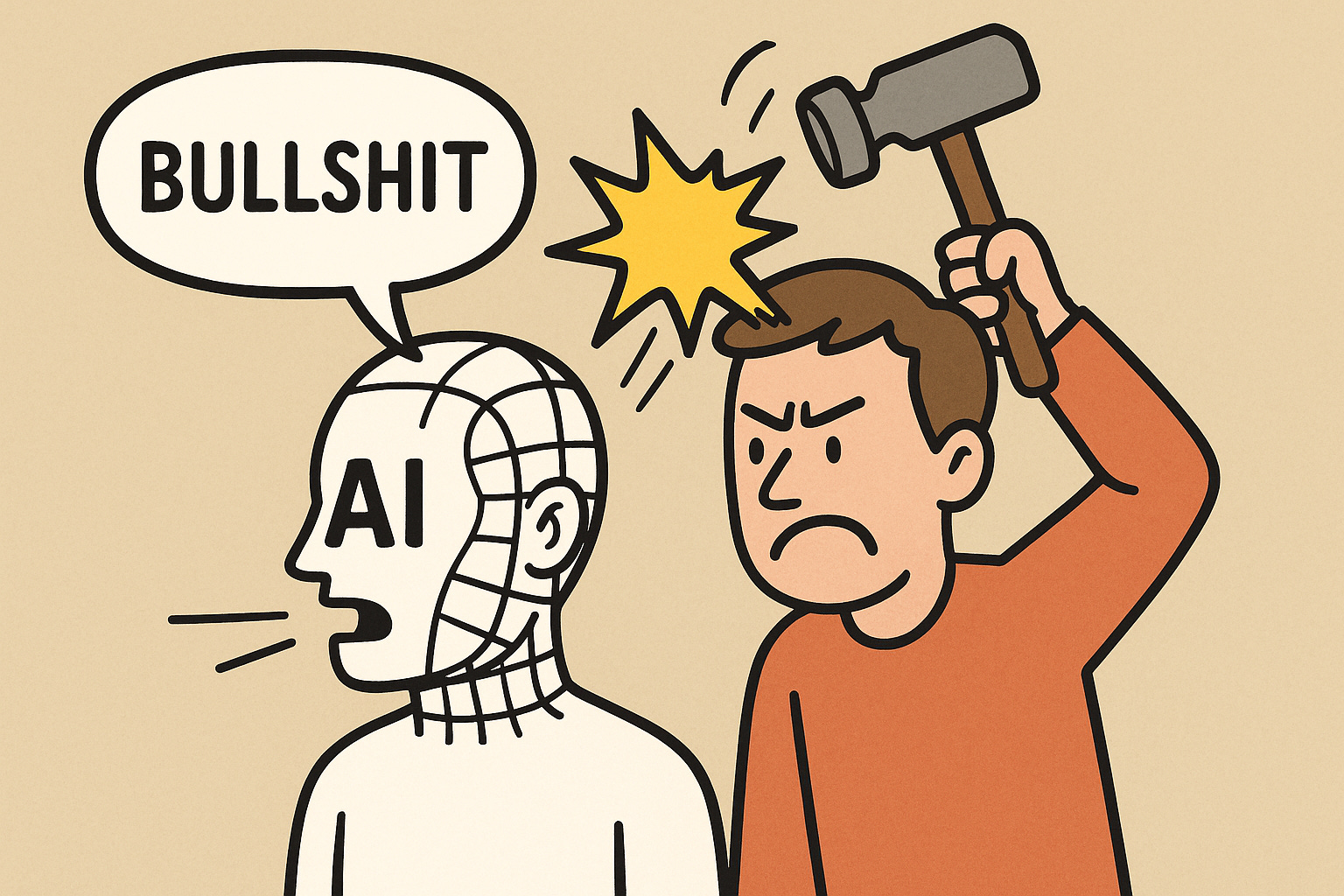
Picture a confident storyteller who never admits uncertainty. Ask them about anything, and they’ll give you an answer that sounds completely plausible. The problem? Sometimes they’re just filling gaps with pure invention.
This is what happens when AI language models hallucinate. They generate text that sounds authoritative but has no connection to reality. An AI confidently invented fake legal cases for a lawyer, leading to courtroom disaster. A search chatbot made up telescope discoveries in front of the world. In customer service, medical advice, or legal assistance, these fabrications cause real harm.
The AI doesn’t lie with malice. It simply doesn’t know the difference between what it learned during training and what it’s creating on the spot to complete a pattern. Modern language models predict the next most likely word based on patterns. When they encounter gaps in knowledge, they don’t pause or admit uncertainty. They keep predicting words that sound right, creating fiction that feels like fact.
Fortunately, researchers and developers have discovered practical ways to keep AI grounded in truth. These strategies range from simple adjustments anyone can make to sophisticated training techniques. Let’s explore how to turn an imaginative storyteller into a reliable assistant.
Sponsored: Speaking of reliable AI, Parlant is an AI agent framework designed to make your agents follow instructions consistently. Instead of wrestling with unpredictable behavior through complex prompts, Parlant lets you define behavioral guidelines in natural language that your agents actually follow. Whether you’re building customer service bots or domain-specific assistants, it helps you create predictable, rule-following agents without constant debugging.
1. Choose Advanced Models
Not all AI models are created equal. Newer, more advanced models typically hallucinate less because they’ve been trained on better datasets and refined with improved methods. Think of it like consulting a seasoned expert versus a novice. The expert is more likely to know the facts or admit when they don’t.
A model from 2024 will generally produce more accurate, consistent answers than its 2022 counterpart. The difference isn’t subtle. You can prevent many hallucinations simply by selecting a model known for factual accuracy. Always evaluate different models on your task. You might find a noticeable drop in fabricated answers by upgrading to one with better training.
2. Write Clear Instructions
AI systems are remarkably sensitive to how you phrase requests. The same model can behave completely differently depending on your guidance. Explicit instructions act like guidelines, narrowing behavior and setting expectations.
Tell the AI: “Answer only with verified information. If you’re not sure, say you don’t know.” This simple instruction can dramatically change behavior. Instead of cheerfully inventing an answer to fill silence, the model might admit uncertainty or ask for clarification. It’s like telling a student that saying “I don’t know” is better than guessing.
This doesn’t work perfectly every time. Language models can still drift from instructions. But explicit prompts about accuracy requirements give the AI less room to improvise incorrectly.
3. Use Step-by-Step Reasoning
Remember math class? Teachers insisted you show your work, not just the final answer. Working through steps reveals whether you truly understand the problem or just got lucky with a guess.
The same principle applies to AI. When models jump straight to answers without reasoning through problems, they often make logical leaps that lead to nonsense. The solution is chain-of-thought prompting: asking AI to think out loud.
Instead of demanding an immediate answer, guide the model: “Let’s solve this step by step.” The AI then breaks down the problem, explains intermediate thinking, and builds toward a conclusion. You can even build your own logic breakdown, prescribing the exact process the model should follow. For example: “First, identify the key variables. Second, check what information is missing. Third, calculate each component separately. Finally, combine the results.”
For more control, you can implement this logic in code as a state graph. Each node represents a reasoning step, and edges define the flow between steps. The AI executes one step at a time, and your code determines what happens next based on the output. This structured approach forces consistency and self-checking along the way. For tasks involving calculations, multi-step logic, or complex reasoning, this dramatically reduces errors.
4. Provide Examples
Show the AI examples of correct behavior through few-shot prompting. Include a few sample interactions demonstrating accurate, factual responses in your prompt, and the model will mimic that style. If your examples occasionally say “I don’t know,” the AI learns that admitting uncertainty is acceptable.
It’s like giving an apprentice solved problems as guides before asking them to tackle new ones. The model follows the patterns you demonstrate. Show it high-quality examples of not inventing information, and it becomes less likely to fabricate answers. Make your examples relevant to the task and demonstrate only the behavior you want to encourage.
5. Ground with Real Data
AI models work from memory. They generate text based on patterns learned during training, which ended at some fixed point in the past. They don’t know what happened yesterday, and their knowledge of even older events might be imperfect.
The most powerful solution is Retrieval-Augmented Generation. Your system fetches relevant information from external sources like databases, documentation, or web searches, then provides those details to the model as context. The AI bases its answer on supplied information rather than potentially faulty memory.
Think of this as switching from a closed-book exam to an open-book one. Imagine someone asks about your company’s return policy. Instead of having the AI guess based on vague training data, your system retrieves the actual policy document and feeds it into the prompt. It’s much harder to hallucinate a fake policy when the real one is sitting right there.
This dramatically improves accuracy. Customer service bots, legal assistants, and medical advisors increasingly use this strategy. The result is trustworthy outputs that users can verify against source material.
6. Lower the Temperature
Language models have parameters that control how adventurous their word choices become. The temperature parameter controls this balance. High temperature encourages exaggeration, dramatic flourishes, and exploration. Low temperature means sticking to straightforward facts.
For tasks requiring accuracy, turning down the temperature helps. At lower settings, the model becomes more conservative and focused. It picks the most likely, straightforward next word rather than exploring fanciful possibilities. Responses may be plainer, but that’s usually preferable when truthfulness matters more than entertainment.
This isn’t about suppressing capabilities. It’s about matching the tool to the task. For creative writing or brainstorming, higher temperature works beautifully. For answering factual questions or generating documentation, dial it down.
7. Implement Self-Checks
After the AI generates an answer, ask it to verify: “Are you sure? Can you double-check that information?” You can even have it generate multiple independent answers to the same question and compare them. If all answers agree, confidence increases. If they diverge, that’s a warning sign.
This resembles having several people solve the same problem independently, then comparing solutions. Discrepancies reveal potential issues. Some systems automate this process, using the model’s own uncertainty or internal disagreement to flag suspicious outputs. It’s like proofreading an essay. A second read spots made-up facts or inconsistencies that the first draft contained.
8. Add External Verification
Instead of trusting the AI’s self-assessment, check facts against trusted databases. If the model outputs a specific statistic, your system can automatically verify it through an API or secondary source. When verification fails, flag the response, correct it, or prompt the model to try again.
This works like an editor checking a journalist’s citations before publication. In high-stakes domains like medicine or law, such guardrails become essential. They ensure questionable claims get caught and corrected rather than reaching users unchecked.
Rule-based frameworks can enforce boundaries too. Define what the AI is and isn’t allowed to do. Require source attribution for certain claims. Prevent responses on topics outside the model’s expertise. These constraints act as safety nets, intervening when the AI starts straying.
9. Fine-Tune on Your Domain
Sometimes the solution is making the model itself more knowledgeable. Fine-tuning takes a general-purpose language model and trains it further on curated data from your specific domain.
Building a medical chatbot? Fine-tune on verified medical literature and documentation. The model learns the jargon, correct facts, and appropriate style for that field. It becomes less likely to produce wild guesses because it has deeper, more accurate knowledge.
This is like sending someone to specialized school. A lawyer trained in contract law won’t confidently make up facts about surgery because they know their domain and its boundaries. Similarly, a fine-tuned model understands what it should know and where its expertise ends.
The process requires quality training data and computational resources, but the payoff is AI aligned with reality in your use case. Many specialized models exist for different domains. Even if you can’t fine-tune models yourself, leveraging these pre-trained specialists reduces hallucinations.
10. Use Human Feedback
The most sophisticated approach involves Reinforcement Learning from Human Feedback. Humans review outputs, flag errors, and suggest corrections. The model learns from these mistakes like an apprentice learning from a mentor. You can implement simpler versions by letting users report incorrect answers. This long-term approach makes the system better over time while other techniques catch immediate errors.
Preventing hallucinations isn’t about one magic technique. It’s about layering multiple strategies that work together. Each layer adds protection. Some hallucinations slip past prompting but get caught by verification. Others get prevented entirely by retrieval augmentation.
The stakes are real. AI systems increasingly handle tasks where accuracy matters deeply. Medical advice, legal guidance, customer support, and educational content all require truthfulness. By understanding how hallucinations happen and how to prevent them, we can build AI that people can actually trust. The technology keeps improving, but the fundamental principles remain: be clear about expectations, provide real information when possible, verify outputs, and keep learning from mistakes.
Related Tutorials
Free Resources
Download free guides, cheatsheets, and templates curated from 130+ tutorials on RAG, AI Agents, and Prompt Engineering.
Also available on Substack
Prefer Substack? This article is also on our newsletter, read by 40K+ AI engineers.
Related Articles
Graph RAG Explained
How Graph RAG combines knowledge graphs with retrieval-augmented generation to deliver more accurate, structured, and contextual AI responses.
The AI Arms Race Is Over. Smart Engineering Won
The era of scaling compute is ending. What's replacing it is smarter engineering, better architectures, evaluation, and deployment patterns.
Why AI Agents Need to Check Their Own Work
Self-verification is the missing piece in most AI agent architectures. Here's how to build agents that validate their own outputs before returning results.
Get More AI Insights Weekly
Join 40K+ AI engineers getting deep dives on agents, RAG, and prompt engineering every week.